
Commercial truck tyres designed for on- and off-highway applications. Built for construction, oil service, mining, logging and waste collection, with retreadable casings.
Mixed-service truck tyres are commercial tyres designed for vehicles that operate on both sealed highways and unsealed or uneven surfaces in the normal course of their work. Unlike long-haul tyres optimised exclusively for highway conditions, or dedicated off-highway tyres designed mainly for unsealed terrain, mixed-service tyres offer a balanced combination of highway ride quality, fuel efficiency and off-highway durability in a single tyre.
The engineering challenge that defines a mixed-service tyre is balancing two competing performance demands. On the highway, the tyre must deliver reasonable fuel efficiency, low noise, even wear and a comfortable ride at sustained speeds. Off the highway, the same tyre must resist cuts and chips from sharp rock, provide traction in mud and loose gravel, expel debris from tread grooves and withstand the impacts of uneven terrain without damaging its internal structure. Achieving both objectives in a single tyre requires careful engineering of the tread pattern, rubber compound, belt package and sidewall construction.
Mixed-service tyres typically feature greater tread depth than highway tyres, often between 24/32 and 28/32 of an inch, providing a larger reserve of wearable material that extends service life in abrasive off-highway conditions. Tread patterns use open-shoulder designs with wide lateral grooves that channel mud, gravel and debris away from the contact footprint, maintaining traction on soft or loose surfaces. Stone ejectors in the base of the grooves prevent stones from working their way in and puncturing the belt package. Rubber compounds are formulated to resist cuts and chips, using blends that resist tearing when the tread contacts sharp rock, broken concrete or metal debris.
Sidewall construction on a mixed-service tyre is typically more robust than on a highway tyre, with additional rubber reinforcement plies and reinforced bead areas that protect against impacts with kerbs, ruts and the general battering that sidewalls endure in off-highway environments. The belt package uses high-tensile steel with wider-gauge edges to resist the punctures and impacts common on construction sites and quarry haul roads. These structural elements add weight compared with a highway tyre, which slightly increases rolling resistance, but the trade-off is necessary for the durability required in mixed-service applications.
Mixed-service tyres are the right choice for any commercial truck operation that regularly moves between sealed roads and unsealed or uneven surfaces. The most common applications include:
Tippers, concrete mixers and materials delivery trucks that travel on highways between projects and then operate on unsealed construction sites with gravel, soil, mud and debris. This is the most common mixed-service application in Antigua and Barbuda.
Service trucks, sand carriers and equipment haulers that travel sealed roads to reach well sites and then navigate unsealed access roads with loose gravel, caliche and soft ground. Tyre reliability is critical in remote locations.
Log carriers and timber trucks that travel sealed roads to sawmills and then access forestry tracks through woodland and hills. These tracks feature steep gradients, sharp rocks, stumps and soft verges that demand both traction and sidewall protection.
Haul trucks and service vehicles operating on sites with abrasive rocky surfaces, steep gradients and heavy loads. Quarry and mine haul roads are among the most demanding environments for truck tyres, requiring maximum resistance to cuts and chips.
Refuse trucks and roll-off container vehicles that collect on sealed residential and commercial routes but also access landfills, transfer stations and demolition sites with unsealed roads, sharp debris and heavy loads.
Utility service trucks, line crews and energy-sector vehicles that maintain infrastructure in both urban and rural environments, frequently accessing remote sites at towers, substations and pipeline easements via unsealed access roads.
Drive and all-position tyres designed for the demands of mixed-service applications on and off highway. Every tyre is built on a retreadable casing with a 3-retread warranty.

Mixed-service steering and all-position tyre from the Krato range. Reinforced sidewalls, wide contact footprint and optimised groove geometry for vocational applications on and off highway. Designed to pair with the HS64+ Krato Mix on drive axles.
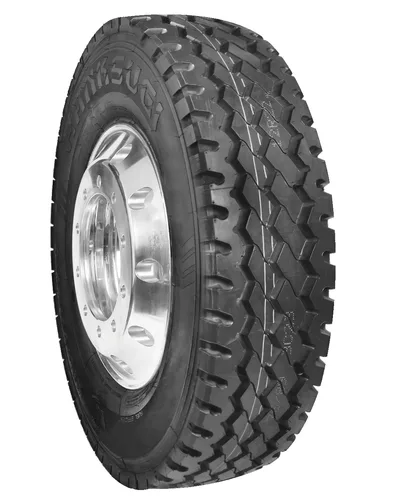
Aggressive mixed-service drive tyre from the Krato range, with a deep lug pattern and integrated stone ejectors. Built for the most demanding construction and mining operations on and off highway, where traction and cut resistance are critical.
Hanksugi mixed-service tyres are available in the most common commercial truck tyre sizes used in construction, oil service, mining and vocational applications in Antigua and Barbuda.
| Model | Position | Available Sizes | Tread Depth | Load Range |
|---|---|---|---|---|
| Drive | 11R22.5, 11R24.5, 315/80R22.5 | 26/32" | H (16-ply) | |
| HS34+ Krato Mix | Steer / All-Position | 12R22.5, 315/80R22.5, 13R22.5 | 20/32" | H-J (16–18-ply) |
| HS64+ Krato Mix | Drive | 12R22.5, 315/80R22.5, 13R22.5 | 28/32" | H-J (16–18-ply) |
Choosing between mixed-service, highway and off-highway tyres depends on the percentage of time your trucks spend on each type of surface and the severity of off-highway conditions. Understanding the trade-offs helps you select the tyre that minimises total cost of ownership for your specific operation.
Mixed-service tyres deliver the optimal balance for operations that divide their time between highway and off-highway surfaces. They offer sufficient fuel efficiency on the sealed road sections of your routes while providing the cut resistance, traction and durability needed for the off-highway portions. For trucks that spend between 40–60% of their time on each type of surface, mixed-service tyres minimise total tyre cost by avoiding the penalties of using a highway tyre off-road (premature failure) or an off-highway tyre on the highway (excessive fuel consumption).
Selecting the right mixed-service tyre for your operation requires evaluating several factors specific to your routes, vehicles and operating conditions. The objective is to match the tyre's design features to the real demands of your application, without over-specifying or under-specifying the tyre for the work it must perform.
Start by estimating how much time your trucks spend on sealed roads compared with unsealed or uneven surfaces. If your trucks operate 70% or more on the highway with occasional access to worksites, a tyre such as the HS84, with its balanced tread design, will offer good highway performance with adequate off-highway protection. If your trucks spend 50% or more in severe off-highway conditions with sharp rock or heavy mud, the HS64+ Krato Mix, with its aggressive deep-lug pattern, is the better option for maximum off-highway durability.
Not all off-highway terrain is equal. A construction site with compacted gravel is far less demanding than a quarry with loose sharp rock or a logging track with stumps and ruts. For moderate off-highway conditions such as construction sites, cleared lots and maintained gravel roads, the HS84 delivers excellent performance. For severe conditions with sharp rock, deep mud, steep gradients and unmaintained tracks, the Krato range offers the additional tread depth, stone ejection and sidewall protection needed to avoid premature failures.
For complete mixed-service coverage, pair a mixed-service steer tyre with a mixed-service drive tyre. The HS34+ Krato Mix is designed specifically as the steering and all-position partner for the HS64+ Krato Mix drive tyre. Using a highway steer tyre with a mixed-service drive tyre leaves the steer position vulnerable to off-highway damage, whereas fitting mixed-service tyres on all positions ensures consistent protection across the vehicle.
In mixed-service applications the casing endures more abuse than in highway service. This makes casing quality even more important, because a casing that survives mixed-service conditions and can be retreaded delivers enormous value. All Hanksugi mixed-service tyres carry a 3-retread casing warranty in Antigua and Barbuda, providing confidence that the casing investment will deliver multiple useful lives even in demanding applications.
Explore other Hanksugi tyre categories for your fleet.
Maximum-durability tyres for trucks that spend the majority of their time on unsealed surfaces, quarry haul roads and heavy worksites.
Heavy-service tyres for tippers, concrete mixers, refuse vehicles and other vocational applications with extreme loads and tight turning.
Low-rolling-resistance highway tyres for maximum fuel efficiency and mileage on long-haul operations. Lower cost per kilometre on sealed roads.
Explore the complete Hanksugi drive tyre range including closed-shoulder, open-shoulder and mixed-service models for every application.
Common questions about mixed-service truck tyres, tyre selection for on- and off-highway use, and maintenance.
A mixed-service truck tyre is designed for vehicles that split their operating time between sealed highways and unsealed or uneven surfaces such as construction sites, quarry haul roads, forestry tracks or access roads at oil-service locations. These tyres combine the ride quality and fuel efficiency of a highway tyre with the durability, traction and puncture resistance needed for off-highway conditions. They typically feature greater tread depth, open-shoulder designs, cut-and-chip-resistant compounds and reinforced sidewalls.
Mixed-service tyres are used by construction companies, oil and gas operators, logging operations, mining contractors, waste collectors, aggregate and concrete delivery fleets, utility companies and any operation that requires trucks to travel on both sealed roads and unsealed or uneven surfaces during the same working day. If your trucks regularly leave sealed roads to reach worksites, mixed-service tyres are the right choice.
Mixed-service tyres are designed for vehicles that spend a significant amount of time on both sealed roads and off-highway surfaces, typically 40–60% on each. Off-highway tyres are designed primarily for unsealed surfaces and may sacrifice highway ride quality and fuel efficiency in exchange for maximum traction and off-road durability. If your trucks spend more than half their time on sealed roads between worksites, mixed-service tyres offer a better balance than dedicated off-highway tyres.
Yes. All Hanksugi mixed-service tyres are built on retreadable casings. Hanksugi guarantees 3 retreads on casings sold in Antigua and Barbuda. The casing construction uses high-tensile steel belts and heat-resistant compounds that maintain structural integrity through 3 guaranteed retreads, even under the demanding conditions of mixed-service applications on Antiguan roads.
The mileage of mixed-service truck tyres varies according to the proportion of highway versus off-highway use, the severity of off-road conditions, the load weight and maintenance practices. In typical mixed-service applications, drive tyres can deliver between 100,000 and 190,000 km on the original tread. Tyres that spend more time on sealed roads achieve higher mileage, while those in heavy off-highway service with sharp rock wear more quickly. Proper inflation management and regular rotation significantly extend tread life.
The inflation pressure for mixed-service tyres depends on axle load and operating conditions. On sealed roads, follow the standard load/inflation tables for your tyre size. On unsealed surfaces, some operators reduce pressure slightly to increase the contact footprint and improve traction on uneven ground. However, never operate below the minimum pressure for your axle load, and always re-inflate to the highway pressure before returning to sealed roads. Insufficient inflation is the primary cause of premature tyre failure in mixed-service applications.