
Cut- and chip-resistant mixed-service tyres designed for construction sites, quarries and demanding on-/off-road operations.
Commercial trucks operating at construction sites, quarries, mining operations and energy-sector access roads face a tyre environment that would destroy a standard highway tyre in weeks. The unsealed surfaces at these worksites are covered with crushed rock, broken concrete, rebar ends, timber scrap studded with nails and sharp aggregate that tear rubber from the tread with every revolution. Standard highway compounds are too brittle for these conditions — they fracture and lose chunks of tread rubber, a mode of degradation known as cut and chip damage that can cut the service life of a highway tyre by 50% or more in off-road service.
All-terrain and construction truck tyres tackle this challenge through three fundamental engineering changes compared with highway tyres. First, the tread compound uses a different rubber formulation with a higher natural-rubber content and specialised reinforcing agents that let the rubber flex around sharp objects instead of fracturing on impact. This cut- and chip-resistant compound absorbs the energy of contact with sharp rocks without losing chunks of tread material. Second, the tread pattern features wider void areas between the tread blocks that allow mud, gravel and debris to clear from the contact patch with every revolution, maintaining traction on soft surfaces where a clogged highway tread would simply spin. Third, the casing construction includes additional protective plies and reinforced sidewalls that protect against the punctures and impact damage that are inevitable in off-road environments.
The challenge for fleet managers is that off-road capability comes with trade-offs. The same aggressive tread pattern that clears mud also generates more noise and rolling resistance on highway surfaces. The deeper tread that provides extended life on uneven roads generates more heat at sustained highway speeds. The cut-resistant compound that survives sharp rocks wears faster on smooth pavement than a formulation optimised for the highway. For this reason, choosing tyres for off-road operations requires understanding the specific duty cycle — the percentage of kilometres on sealed versus unsealed surfaces, the severity of off-road conditions and the speed requirements on highway stretches — to find the tyre that delivers the best overall performance across the whole route, not just on the worksite portion.
Open-shoulder drive, mixed-service and all-position tyres with cut- and chip-resistant compounds built to survive construction sites, quarries and uneven terrain while maintaining acceptable highway performance.
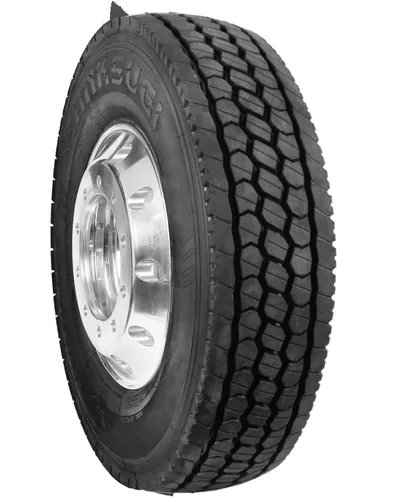
Open-shoulder drive tyre with rock protection and a crack- and chip-resistant compound. Wide tread footprint with four decoupling grooves for traction on loose, uneven surfaces. Excellent for mixed highway/worksite operations.
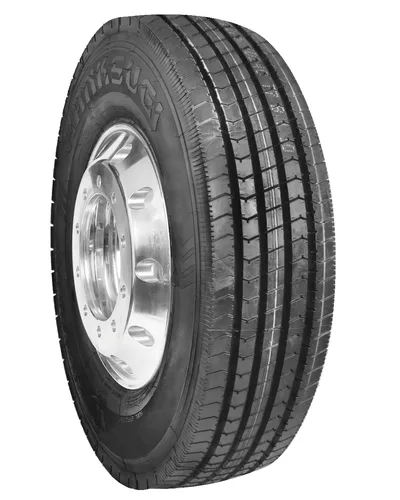
All-position tyre with extra-deep 15.5mm tread and sidewall protection for construction and all-terrain applications. Retreadable casing with excellent dry and wet performance in steer, drive and trailer positions.
The engineering of all-terrain and construction tyres focuses on three areas that highway tyres barely consider: compound durability against sharp objects, self-cleaning capability of the tread pattern, and casing protection against impacts and penetration.
The tread compound is the first line of defence against off-road damage. Cut- and chip-resistant compounds use higher proportions of natural rubber, which has inherently better tear resistance than synthetic rubber. These compounds also incorporate specialised carbon-black and silica fillers that reinforce the rubber matrix at a molecular level, allowing the tread to absorb impacts from sharp rocks without fracturing. The HS84 uses an advanced cut- and chip-resistant compound that delivers measurably longer tread life on aggregate surfaces compared with standard highway compounds. This technology lets the tread flex around sharp objects instead of fracturing, preventing the loss of chunks that destroys highway tyres in off-road service.
Stone drilling is one of the most insidious forms of tyre damage in construction and quarry operations. Stones lodge in the tread grooves and are driven deeper with every revolution until they penetrate the tread rubber and make contact with the steel belt package. Once moisture reaches the belts through the channel bored by the stone, corrosion begins, eventually causing belt separation and catastrophic failure. The HS84 features stone-ejection ribs — small ridges at the base of the tread grooves that prevent stones from seating deeply enough to start drilling. These features actively push stones out of the grooves as the tread flexes during rotation, keeping the grooves clean and protecting the belt package.
All-terrain tyres face sidewall hazards that highway tyres never encounter: rocks thrown up by other vehicles, debris along the edges of unsealed roads, stumps and chunks of concrete at construction sites, and constant flexing over uneven surfaces. The all-position HS76 includes integrated sidewall protection that adds material thickness and impact resistance in the vulnerable area between the tread edge and the bead. This additional ply absorbs impacts that would cut a standard sidewall, preserving casing integrity and extending tyre life. Maintaining proper inflation pressure is equally critical, since an underinflated sidewall flexes more and is more vulnerable to punctures.
Different off-road industries present distinct tyre challenges. The right tyre depends on the specific hazards, the loads and the highway/worksite ratio of your operation.
General construction sites present a mix of hazards: loose aggregate on access roads, debris with rebar and nails in preparation areas, and uneven terrain in excavation zones. Trucks operate at low speeds on site but must maintain highway capability for trips between projects. The is the leading drive-tyre recommendation for general construction because its cut- and chip-resistant compound handles the mixed debris environment while the stone-ejection features protect against the gravel common on construction access roads. For operations that spend more time on sealed roads between worksites, the HS68 provides good traction on loose surfaces with better fuel efficiency on the highway.
Quarry operations are the most demanding environment for commercial truck tyres. The surfaces are covered with freshly crushed rock that has razor-sharp edges, the slopes are steep and the loads are at maximum legal weight or above. Tyres in quarry service face constant exposure to cutting and chipping from sharp aggregate, drilling from stones lodged in the grooves, and excessive heat generation from heavy loads on steep gradients. The with its top-grade cut- and chip-resistant compound is the strongest recommendation for drive positions in quarries. Check and remove lodged stones daily, and maintain strict inflation discipline — heavy loads and steep gradients in quarry operations generate enormous heat in underinflated tyres.
Energy-sector trucks — oil & gas service vehicles, pipeline-construction support, wind-farm logistics — travel long distances on sealed highways to reach remote worksites connected by poorly maintained access roads. The highway-to-off-road ratio is typically higher than in construction or quarry operations, which makes fuel efficiency on highway stretches more important. The HS68 is well suited to energy-sector operations because its open-shoulder design handles unsealed access roads while its tread compound offers acceptable fuel economy over the long highway stretches. The rock protection is particularly valuable on the crushed-rock surfaces used for access roads to pipeline easements.
Logging roads present unique hazards that differ from construction or quarry environments: soft, muddy surfaces that require an aggressive self-cleaning tread; stumps and roots that threaten sidewalls; and steep gradients that demand maximum traction. The combination of heavy loads (loaded logging trucks are among the heaviest legal vehicles on the road) with poor surface conditions means logging operations need tyres with aggressive drive patterns and structural strength. The all-position HS76 offers versatility for operations that need a single tyre model across multiple axle positions, with the sidewall protection and deep tread that logging demands. For dedicated drive positions on logging trucks, the provides maximum traction and cut resistance.
On sealed highways, tread voids (the grooves and channels between tread blocks) serve mainly as water channels preventing hydroplaning. The size and depth of these voids are minimised on highway tyres to reduce rolling resistance and noise. Off-road, the voids serve a completely different purpose: they must accept, temporarily retain and then expel the mud, clay, sand, gravel and debris that the tyre collects with every revolution.
A tyre with shallow voids or tightly grouped tread blocks will pack with mud in minutes on a soft-surface worksite, turning the tread face into a smooth drum with no traction. Once the voids are packed, the tyre spins on the surface instead of gripping it, and the truck gets stuck — a costly delay on any worksite. Self-cleaning tread designs use wider void areas with specific incline angles that let the packed material be expelled as the tread block enters the contact patch and deforms under load. The blocks are shaped so that compression during ground contact forces the mud and debris outward from the groove centres, and the expansion as the block leaves the contact patch opens the voids again to accept fresh material.
The open-shoulder design of the HS68 and the aggressive void geometry of the HS84 both incorporate self-cleaning principles. The four decoupling grooves of the HS68 act as primary ejection channels that evacuate material from the tread centre outward. The wider, deeper grooves of the HS84 with stone-ejection features provide both self-cleaning ability on soft surfaces and protection against stone drilling on hard aggregate surfaces. For operations that encounter both mud and rock (common in general construction), the dual-purpose void design of the HS84 addresses both challenges at once.
Tyres in all-terrain and construction service face more opportunities for damage per kilometre than any other application. A disciplined maintenance programme does not prevent all damage — some tyre loss is an inevitable cost of operating in hostile environments — but it dramatically reduces the rate of preventable failures and extends the average service life of tyres across the fleet.
All-terrain tyres must be inspected daily, not weekly. Before each shift, the driver or tyre technician should walk around the vehicle and visually check each tyre for embedded objects (stones, metal, timber), cuts or bulges in the sidewall, loss of tread chunks and any sign of air loss. After each shift or each trip to a worksite, a second inspection catches damage that occurred during the work period. Focus on the tread grooves — probe with a tyre tool to remove any stone lodged in the grooves, particularly in the central ribs where stone drilling starts. Detecting an embedded nail or stone early, before it opens a path to the belt package, is the difference between a simple plug repair and a discarded casing.
Off-road operations impose unique stress on inflation management. Heavy loads carried over uneven surfaces demand maximum inflation pressure to support the load and prevent sidewall flexing. At the same time, uneven surfaces generate more heat than smooth pavement, and the frequent starts and stops at worksites add thermal cycles that make the pressure fluctuate. Check the pressures before the first trip each day. If trucks operate in extreme heat (summer construction in hot climates), late-afternoon pressures can rise 10-15 PSI above the cold pressure, which is normal and should not be bled off. Bleeding hot tyres leaves them underinflated once they cool. Set the cold inflation pressure according to the load/inflation tables for your tyre model and the actual axle load.
All-terrain tyres suffer more repairable damage than highway tyres, making repair procedures a significant factor in total tyre cost. Small punctures in the tread area (nail holes, small stone penetrations) can be repaired with a plug-patch combination if the damage has not reached the steel belts. Sidewall damage is never repairable — any cut or puncture that exposes the casing cords in the sidewall area requires immediate removal of the tyre and its disposal. Cuts in the tread that remove large chunks of rubber but do not penetrate to the belt package can stay in service, but the tyre should be moved to a less critical position (trailer instead of drive) and monitored closely. Keep detailed repair records for each tyre; a casing with too many repairs may not be suitable for retreading even if the tread depth is adequate.
All-terrain service is harder on casings than highway service, but well-maintained all-terrain tyres can still produce retreadable casings. The key is maintaining proper inflation (which prevents the internal-heat damage that kills casings), avoiding sidewall impact damage, and pulling tyres at the correct tread depth before the casing is exposed to excessive heat and wear. The Hanksugi retread programme uses non-destructive testing to evaluate all-terrain service casings, and experienced inspectors can identify the internal damage patterns specific to off-road use. Casings that pass inspection can be retreaded with mixed-service tread patterns matched to the intended second-life application.
Find the right Hanksugi tyre for your specific operation.
High-strength tyres for tippers, concrete mixers, waste-collection vehicles and vocational applications with extreme loads and tight turns.
Low-rolling-resistance highway tyres for long-distance operations. SmartWay-verified steer, drive and trailer tyres for maximum fuel efficiency.
Open-shoulder drive tyres and scrub-resistant steer tyres for LTL, pick-up and delivery, and urban distribution routes.
Complete range of drive tyres: closed-shoulder, open-shoulder and mixed-service models for every drive-axle application.
Common questions about all-terrain truck tyres, construction tyres and choosing mixed-service tyres.
A mixed-service truck tyre is designed for vehicles that split their time between sealed highways and unsealed worksites. Unlike highway tyres, which prioritise fuel efficiency, mixed-service tyres use cut- and chip-resistant compounds that withstand sharp rocks, gravel and debris. They feature deeper tread with wider voids for self-cleaning in mud, stone-ejection features to prevent stone drilling into the belt package, and reinforced sidewalls to resist punctures and impact damage from off-road hazards.
Cut and chip damage occurs when sharp objects on the road surface tear pieces of rubber from the tread. Crushed rock, broken concrete, steel debris and sharp aggregate at construction sites are the main culprits. Standard highway tyre compounds fracture and lose chunks of tread rubber. Mixed-service compounds such as the one in the Hanksugi HS84 use a higher natural-rubber content that lets the tread flex around sharp objects instead of fracturing, significantly extending tread life in off-road environments.
Yes, all-terrain mixed-service tyres are designed for dual-use scenarios. They must travel public highways to reach worksites. However, they have higher rolling resistance than highway tyres, which increases fuel consumption on sealed roads. The trade-off is worthwhile when more than 20% of the kilometres involve unsealed or uneven surfaces. If less than 20% is off-road, a regional tyre such as the HS68 can deliver a better total cost thanks to its lower rolling resistance on the highway.
Stone drilling occurs when small stones lodge in the tread grooves and are pushed deeper with each revolution until they penetrate through the tread to the steel belts. This creates a path for moisture that causes corrosion and belt separation — a serious structural failure that can cause blowouts. The stone-ejection features in mixed-service tyres prevent stones from seating deeply enough to reach the belts. Regular inspection and removal of lodged stones is also an important preventive maintenance task.
The service life of all-terrain tyres varies more than any other application. A mixed-service tyre on well-maintained gravel roads can deliver between 130,000 and 190,000 km. The same tyre in a rock quarry with sharp aggregate might last between 60,000 and 100,000 km. The key factors include the sharpness of the surface aggregate, the steepness of the slopes, the frequency of turns and the ratio of highway to off-road kilometres. Proper inflation management and regular stone removal have a greater impact on tyre life in off-road service than in any other application.
Sidewall protection features include thicker sidewall rubber, sidewall ribs that deflect rock impacts, wider profiles between the beads that reduce the exposed sidewall area, and reinforced bead construction for uneven surfaces. The Hanksugi HS76 includes integrated sidewall protection for use in construction and mixed service. Maintaining proper inflation pressure is equally important — an underinflated tyre has a more flexible sidewall that is more vulnerable to punctures and impact damage.