
Tyres resistant to cuts, chips and chunking for surface mining, underground operations and haul trucks in quarries. Maximum durability on the toughest surfaces.
Mining operations subject commercial truck tyres to conditions that no other application matches. The combination of extreme loads, abrasive rocky surfaces, sharp debris, steep gradients, slow speeds and high ambient temperatures creates an environment that exposes every weakness in the design and compound of a tyre. A tyre that performs well on highways or in regional delivery service will often fail within weeks, or even days, in a mining environment. Understanding why mining is so hard on tyres is the first step in selecting the right product and setting realistic expectations for service life.
The road surfaces in mining operations are made up of the same material that is being extracted. In a granite quarry, the haul roads are built from crushed granite with angular edges as sharp as knives that cut the tread rubber with every revolution. In coal mining, the roads can include fragments of shale that embed in the grooves and pierce the belt package. In copper mining, the haul roads can reach surface temperatures above 65°C in late summer, adding extreme thermal stress to the mechanical abuse. Unlike sealed highways that have a relatively even surface, mining haul roads change in character with each load of material that is spread, creating inconsistent surface conditions that prevent tyres from developing predictable wear patterns.
Payloads in mining constantly reach the maximum capacity of the truck and often exceed it. An overloaded mining truck not only wears tyres faster; it fundamentally changes the distribution of stresses inside the tyre, concentrating forces in the shoulder area and raising the internal temperature beyond the design parameters of the compound. Fleet managers who invest in on-board scales and enforce load limits at the shovel consistently achieve better tyre service life than operations that load solely by volume estimate.
Hanksugi offers multiple tyre models suited to the demands of mining and quarry service. The HS76 mixed-service all-position tyre provides sidewall protection and a deep tread for all-position use on mining haul trucks. The HS68 open-shoulder drive tyre uses stone protection and a wide-tread geometry for drive traction on loose and gravel surfaces. The HS66 trailer tyre serves mining trucks that travel highway sections between the mine and the processing plants. Every tyre is built on a retreadable casing, allowing operations to extract the maximum value from their initial investment in tyres.
Different mining operations create different challenges for tyres. A tyre that performs well in one mine can fail rapidly in another because the type of rock, the gradient of the haul road and the operating conditions vary widely. Selecting the right tyre starts with understanding your specific environment.
All-position, drive and trailer tyres selected for the extreme demands of mining, quarry and aggregate haulage operations. Built to resist cut, chip and chunk damage on the toughest surfaces.
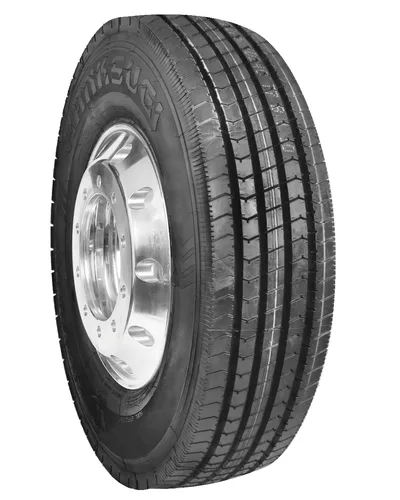
Mixed-service all-position tyre with extra-deep tread and reinforced sidewall protection. Retreadable casing. Designed for performance in dry and wet conditions on mining haul roads and quarry surfaces.
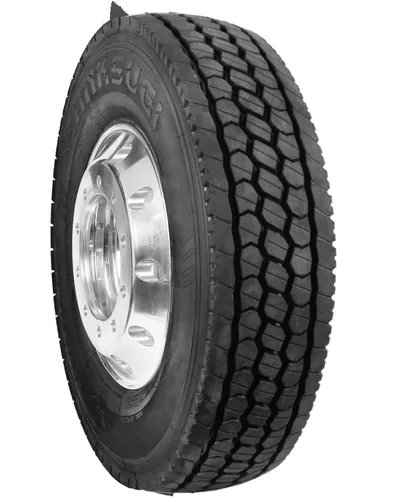
Regional open-shoulder drive tyre with stone protection and four stone-ejector grooves. Wide tread footprint that delivers traction on loose gravel roads while resisting stone retention in the tread voids.
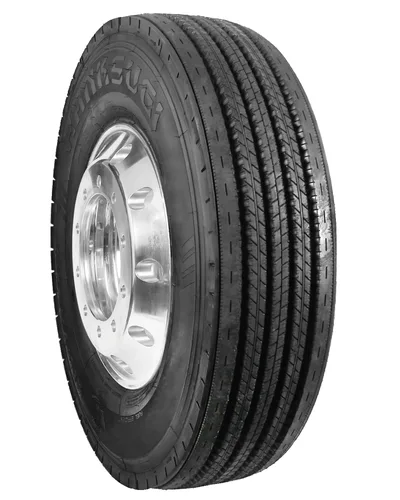
Free-rolling trailer tyre with low rolling resistance for mining trucks that travel highway sections. Fuel-efficient on public roads and capable of handling the transition to rough mine roads.
Cut, chip and chunk damage (CCC) is the main failure mode of tyres in mining operations. It is fundamentally different from the tread wear that limits service life on highways, and it requires a different approach to tyre choice and management. Understanding the mechanics of CCC damage helps fleet managers choose the right tyres and identify operational changes that can extend service life.
When a tyre rolls over the sharp edge of a rock, the rock applies a concentrated force over a small area of the tread surface. If the force exceeds the tear resistance of the rubber compound, the rock cuts the tread, creating a small incision. With repeated contacts across thousands of revolutions, these cuts propagate and small rubber chips separate from the surface of the tread. As the cuts deepen and connect, larger chunks of compound break off the lug surface, exposing the underlying structure to accelerated damage. In severe cases, chunking can remove entire lugs down to the belt package in just a few hundred hours of operation.
The rubber compound is the most important factor in CCC resistance. Standard highway tyre compounds use softer formulations that prioritise grip and low rolling resistance on smooth pavement. These compounds tear easily when exposed to sharp rocky edges. Mining-grade compounds use a higher natural rubber content, reinforced filler systems and cross-linking chemistry optimised for tear resistance rather than hysteresis. The Hanksugi HS76 uses a compound formulated specifically for mixed-service applications where CCC resistance is critical. The compound balances tear resistance against heat generation to prevent the secondary failure mode of thermal degradation that affects compounds which are too hard at low speeds.
The condition of haul roads has a greater impact on the service life of a mining tyre than almost any other variable. A well-maintained haul road with adequately graded surfaces, controlled drainage and proper crown can extend tyre service life by 25 to 40 percent compared with a neglected road of the same material. Watering the roads to control dust also reduces the abrasive action of fine particles on the tyre surfaces. Rolling the crushed material to break the sharp edges before it becomes the road surface reduces the cutting action that starts CCC damage. Mining operations that invest in road maintenance crews and grading schedules consistently report lower tyre costs per tonne of material moved than those that treat haul roads as an afterthought.
Mining trucks operate at low speeds carrying heavy loads on grades. That combination produces intense internal heat inside the tyre. Unlike highway driving, where speed creates the airflow that cools the tyre surface, mining trucks moving between 24 and 40 km/h generate minimal cooling airflow, while the mechanical flexing of the tyre under maximum load continuously pumps heat into the rubber. The temperature in the shoulder area of a fully loaded mining tyre can exceed 105°C on a hot day. At these temperatures, the rubber compounds begin to degrade, losing tear resistance and becoming more susceptible to CCC damage. Correct inflation pressure is critical for managing heat in mining tyres. Tyres with low pressure flex more, generate more heat and fail sooner. Check the pressure daily and consider TPMS for critical haul trucks.
Tyre cost is one of the five main operating expenses in most mining operations and, unlike fuel and labour, tyre cost is highly controllable through operating practices. The difference between a well-managed tyre programme and a poorly managed one in a quarry or mine can represent between 30 and 50 percent of the total annual tyre expense.
In mining, correct tyre inflation is not just important; it is the single practice with the greatest impact on tyre cost control. A mining tyre running 20% below its required inflation pressure generates up to 40% more internal heat. At the loads and speeds of mining operations, that excess heat degrades the compound in hours, not kilometres. Check the pressure on all positions before each shift and attend to slow leaks immediately. A TPMS system on a mining truck pays for itself with the first tyre failure it prevents. Target pressures must be set based on the actual axle weight with loaded trucks, not on estimates.
Overloading is chronic in mining. Shovel operators load by bucket count or visual estimate, and both methods routinely exceed the rated payload of the truck. Even a 10% overload concentrates stress in the shoulder area of the tyre and dramatically increases the rate of CCC damage by pressing the tread with greater force against the rocky edges. Fit on-board scales or load monitors on haul trucks and set strict limits on the rated load. Record load data by shift and shovel operator to identify loading patterns that systematically overload the trucks. The cost of on-board scales is trivial compared with the tyre savings achieved by eliminating chronic overloading.
Haul road maintenance is tyre maintenance. A dedicated grading crew that keeps the haul road surfaces smooth, properly crowned and free of large loose rocks will save more in tyre costs than any other single investment. Water the roads to control dust and reduce surface abrasion. Grade the roads on a regular schedule rather than waiting for complaints to appear. Where possible, use finer crushed material for the running layer of haul roads to reduce the sharpness of rocky contacts. Limit vehicle speeds on haul roads to reduce the energy of rocky impacts on the tread. A well-maintained road can extend tyre service life by up to 40%.
A retreadable mining tyre casing can save between 40 and 60 percent of the cost of a new tyre. But the casings must be removed before the tread wears down to the belt package. In mining, where CCC damage can quickly expose the belts in localised areas, this means monitoring the condition of the tyres more frequently than in highway applications. Inspect the tyres weekly for deep cuts that approach the depth of the belts and remove the tyres before localised damage compromises the casing. Tag the removed tyres with the truck number, the position and the reason for removal, so that the retreading workshop can assess each casing with full operational context. Visit our retreading page to learn more about Hanksugi's casing acceptance criteria.
This guide covers the commercial truck tyre sizes used on road-going mining vehicles, not the giant off-road tyres used on haul trucks in open pits. If your mining trucks operate on public roads between mining sites and processing plants, these are the sizes and models that serve your operation.
| Tyre Size | Application | Hanksugi Models | Details |
|---|---|---|---|
| 11R22.5 | Steer, drive and trailer on mining haul trucks | HS68, HS66 | See Size Guide |
| 11R24.5 | Drive and trailer in heavy mining configurations | HS68 | See Size Guide |
| 295/75R22.5 | Drive and trailer on mine-to-highway trucks | HS68, HS66 | See Size Guide |
| 295/80R22.5 | All-position for mining operations in Anguilla | HS76 | See Size Guide |
| 285/75R24.5 | Drive on tandem-axle vocational mining trucks | HS68 | See Size Guide |
The choice of mining tyres depends on the specific type of rock, the haul road conditions and the truck configuration in your operation. Our fleet solutions team can visit your mine or quarry to assess the conditions and recommend the optimal tyre configuration for your trucks. Contact us for a tyre cost analysis specific to your site.
Common questions about mining truck tyres, quarry applications and resistance to cuts, chips and chunking.
Mining truck tyres use tread compounds resistant to cuts, chips and chunking that withstand sharp, rocky surfaces, deeper tread depths for longer service life at low speeds, reinforced sidewall construction that resists impact damage, and higher load ratings for concentrated mineral loads. The rubber compounds are formulated to resist the abrasive action of crushed rock, which wears standard highway tyre compounds at an accelerated rate.
The service life of mining tyres varies dramatically according to the operation. Surface mining with well-maintained haul roads can reach between 50,000 and 80,000 km. Quarry operations with sharp aggregate typically achieve between 20,000 and 50,000 km. The main factors are rock sharpness, the condition of the haul road, loading practices and the operating speed. Measuring tyre service life in service hours is often more meaningful than in kilometres in mining, since speeds are low.
Road-going mining trucks typically use 11R22.5, 11R24.5 or 295/80R22.5 tyres. These are standard commercial truck sizes for Class 7 and Class 8 vehicles that transport material on public roads between mines, quarries and processing plants. They are distinct from the enormous off-road haul trucks used within mining pits, which use giant tyres in sizes such as 27.00R49.
CCC damage occurs when sharp rocky edges cut the rubber of the tread, tearing away small pieces with each contact. The road surface is often made up of crushed rock with sharp angular edges. As the tyre rolls, the lugs contact these edges, accumulating cuts that eventually propagate into larger chips and chunks. Granite and basalt quarries are particularly aggressive due to the extreme hardness and sharpness of the aggregate.
Yes, mining truck tyres can be retreaded if the casing passes inspection. The key is to remove the tyres before the tread wears down to the belt package and to maintain correct inflation throughout the service life. A retreadable mining casing can save between 40 and 60 percent of the cost of a new tyre. Visit our retreading page for more details.
The most effective strategies are: maintaining the correct inflation pressure, matching the tyre choice to the conditions of the mine, maintaining the haul roads to reduce exposure to sharp rocks, enforcing payload limits at the shovel, implementing a tyre monitoring programme and preserving casings for retreading. Road maintenance alone can extend service life by 25 to 40 percent. Combined, these practices can reduce the cost per tonne of tyre by between 30 and 50 percent compared with unmanaged programmes.